
What do climate models say about the impact of Stratospheric Aerosol Injection on the monsoons?
Published:
Climate models show that stratospheric aerosol injection in one hemisphere only or at the equator would have detrimental impacts on tropical precipitation. However, those detrimental impacts disappear in climate models with equal injection of aerosols in both hemispheres away from the tropics.
What are monsoons?
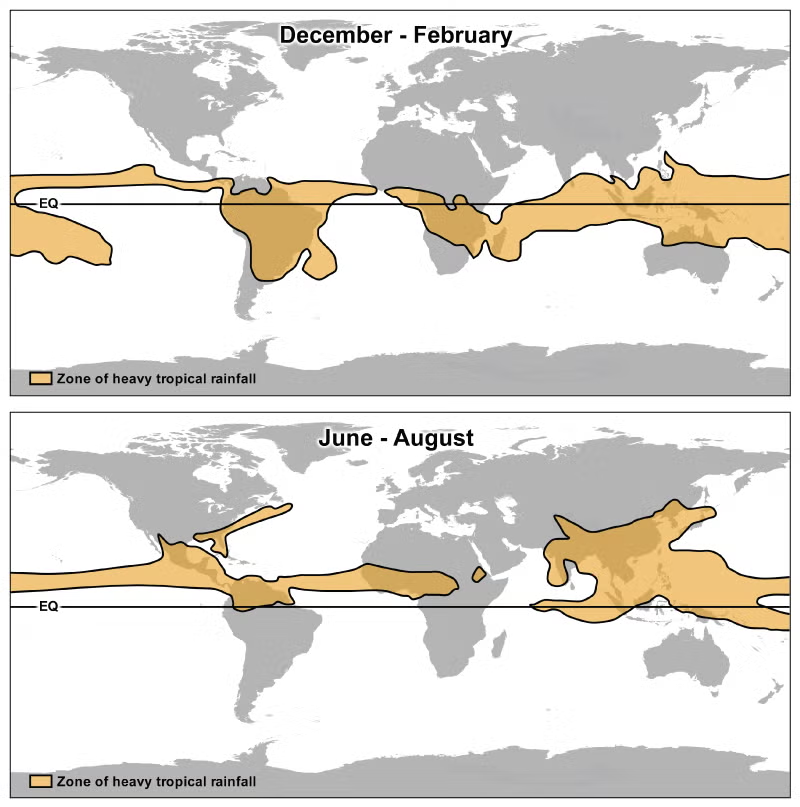
Monsoons refer to seasonal changes in atmospheric circulation and rainfall. The maps below from UCAR show the seasonally varying areas of high tropical rainfall for December- February and June-August. Several billion people depend on the monsoon rainfall for agriculture and water, hence any large changes caused by global warming or climate intervention need to be carefully studied.
Detrimental impacts from single-hemisphere stratospheric aerosol injection
As the map above shows, the area of high tropical rainfall sits mainly within the warmer hemisphere, i.e. North of the equator in June-August and South of the equator in December-February.
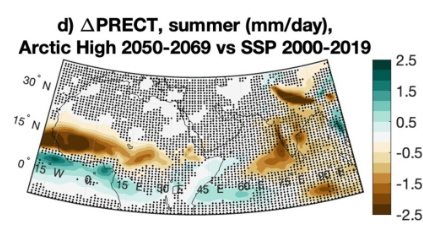
Similarly, if one were to inject stratospheric aerosols in one hemisphere only, that would preferentially cool that hemisphere, and push this belt of high precipitation towards the other hemisphere. This was observed in the context of volcanic eruptions, whereby three of the four driest Sahelian summers were preceded by substantial Northern Hemisphere volcanic eruptions (Haywood et al. 2013). Haywood et al. (2013) go on to show that, in a climate model, continuously adding a large amount of stratospheric aerosols in the Northern hemisphere dries the Sahel, whereas adding aerosols in the Southern hemisphere leads to greening of the Sahel.
In a similar vein, Lee et al. (2023) showed that summer precipitation in the Sahel was reduced when injecting aerosols at 60 degrees North only with the objective of maintaining September Arctic sea ice at ~2010 levels in a middle-of-the-road greenhouse gas emission scenario (SSP2-4.5).
Detrimental impacts from tropical injection
Early work from Robock et al. (2008) showed that injecting sulfur dioxide either just in the Arctic or in the tropics would strongly impact the Asian and African summer monsoons.
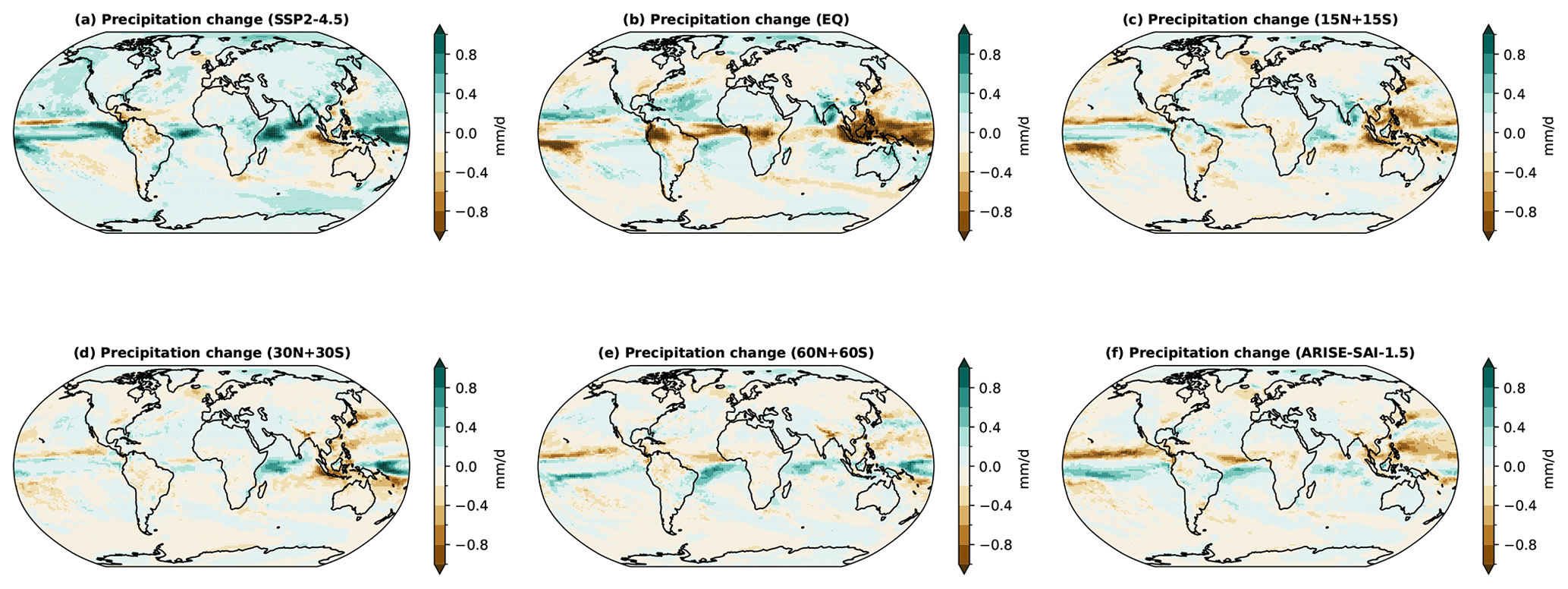
In some of our recent work (Henry et al. 2024) using the UK Earth system model, we found similar large impacts on tropical precipitation for equatorial injection of sulfur dioxide. The maps below show the change in rainfall between the later part of this century compared to ~2020. Panel a shows rainfall changes under a moderate greenhouse gas emission scenario (SSP2-4.5), and panels b,c,d,e, and f show scenarios where global temperature is maintained at ~2020 levels by injecting sulfur dioxide at the equator (b), at 15 (c), 30 (d), and 60 (e) degrees North and South. Equatorial injection (panel b) strongly reduces tropical rainfall, while 30 and 60 degree injection (panels d, e) does not, suggesting that injection away from the tropical regions could reduce the risk of monsoon disruption.
Precipitation changes under hemispherically balanced injection away from the equator
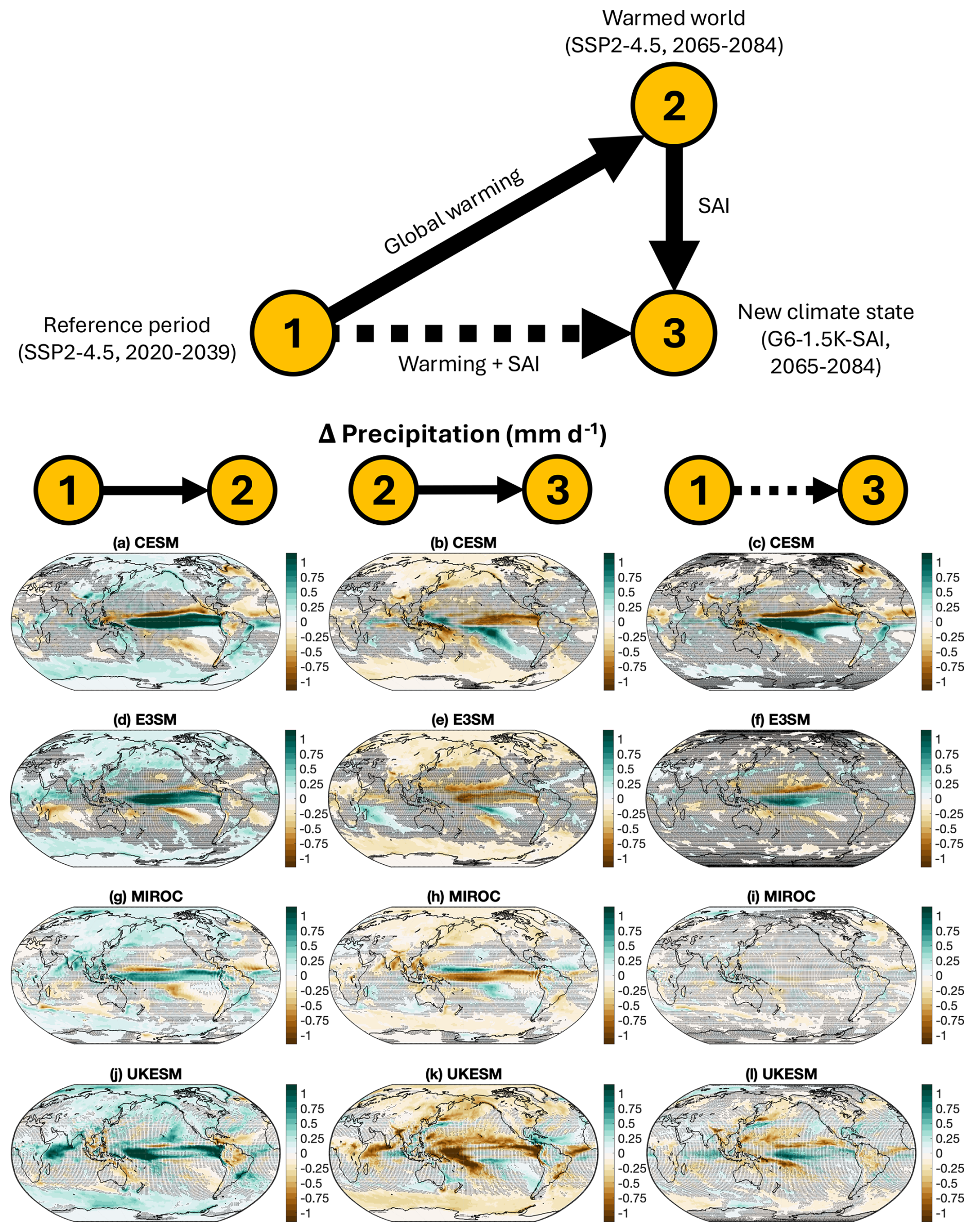
Similarly, the new set of GeoMIP simulations (Lee et al. 2026) which inject equal amounts of sulfur dioxide at 30 degrees North and South do not show strong reductions in precipitation over tropical land. The figure below shows the results from this experiment across four different models: the first column shows the increase in precipitation from global warming, the second column shows the net effect of the sulfur dioxide injection, and the third column shows the residual change in rainfall. A lot of the decrease in rainfall in the second column offsets the increase from the warming in the first column, but important regional residual changes remain, especially in the tropics. And, while changes over land are mostly small, for a given region, models do not agree on the sign of precipitation change (third column). It’s also important to note that these maps show annual-mean precipitation, which could hide important seasonal differences.
Conclusions
Understanding regional precipitation changes remains a crucial step for any rigorous assessment of the climate impacts of stratospheric aerosol injection. It is clear that injection of sulfur dioxide in one hemisphere only or at the equator would have detrimental impacts on tropical precipitation. However, those detrimental impacts disappear in climate models with equal injection of aerosols in both hemispheres away from the tropics. Models could still be wrong and uncertainties are large, but they don’t show that well-designed SAI systematically disrupts the monsoon.
Leave a Comment