
A simple, robust mechanism for reduced high-latitude land seasonality in climates with high carbon dioxide.
Published:
We released a new preprint looking at why a/ Arctic land seasonality keeps decreasing in high-emissions scenarios even after sea ice has fully melted (see first figure below) and b/ better understand past warm climates which had exceptionally warm Arctic winters.
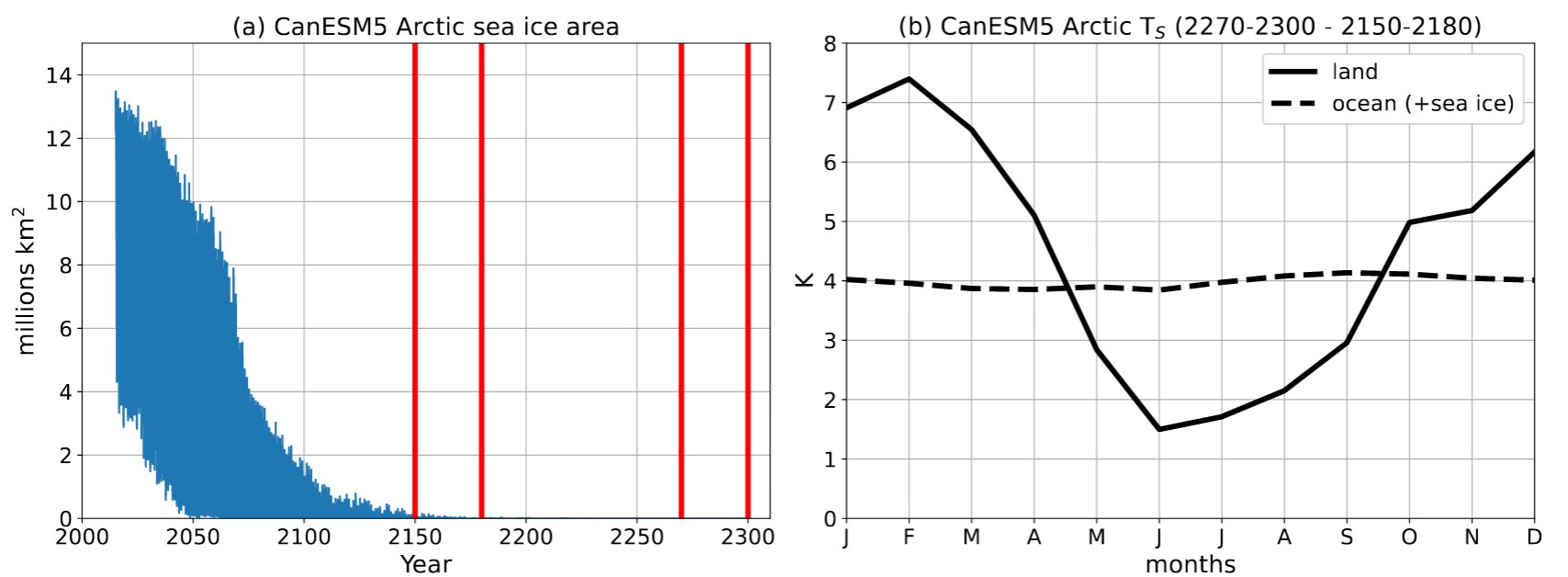
The figure below shows Arctic sea-ice area (a) and Arctic surface temperature change (b) between the two periods limited by red lines in (a). In this high-emissions scenario, once the sea ice is gone, the ocean warms uniformly throughout the year, whereas the land warms more in winter and less in summer, hence reducing its seasonality. This is also qualitatively true in other comprehensive models.
This is also relevant to our understanding of equable climates such as the early Eocene, which had particularly warm Arctic winters. It was initially thought that climate models did not appropriately reproduce the pattern of temperature from these past warm climates: the models had either warm tropics or cold high latitudes. Hence various mechanisms were proposed to explain the gap between proxies and models. However, others argue that proxies allow for higher tropical temperatures than previously considered, which means that a high CO2 concentration alone may be enough to adequately model the Eocene climate. See Kiehl and Shields (2013) and Huber and Caballero (2013) for example.
Our question: is there a robust mechanism to explain why CO2 alone would be particularly effective in warming Arctic land winters?
Leave a Comment